An RO membrane may look simple from the outside, but its performance depends on several things working together: the membrane sheet, the way it is rolled, the glue lines, the feed spacer, the permeate carrier and the final sealing. A defect in any one of these areas can affect purified-water output, salt rejection or the working life of the element.
That is why dependable RO membrane manufacturers in India do not treat quality testing as one final inspection. Testing usually begins with incoming material checks, continues during assembly and ends with performance verification before the membrane is packed. The exact procedure varies by manufacturer and membrane type, but the core objective remains the same: confirm that the membrane is built correctly and performs within its declared specifications.
Why membrane testing matters
The RO membrane is the separation stage at the heart of a purifier. Feed-water pressure pushes water across a semi-permeable layer while a large proportion of dissolved salts and other contaminants remain in the reject stream. If the membrane sheet is damaged, the glue line leaks or the element is rolled incorrectly, water may bypass the intended separation path.
For an RO brand, distributor or service network, inconsistent membranes create problems that go beyond one replacement. They can lead to variable TDS reduction, slow filling, repeated technician visits and avoidable customer complaints. A controlled quality process reduces this variation before the product enters the market.
1. Incoming material inspection
Quality begins before the membrane is assembled. Manufacturers typically inspect the membrane sheet and supporting materials against defined specifications. The sheet may be checked for visible scratches, folds, contamination, uneven coating or edge damage. Feed spacers, permeate carriers, central tubes, end caps and outer wrapping are also checked for dimensional and visual consistency.
This stage matters because a finished element cannot compensate for a defective raw material. Batch identification and traceability are equally important: if a problem appears later, the manufacturer should be able to connect the finished membrane to its material lot and production record.
2. Dimensional and construction checks
During assembly, technicians verify the element’s length, diameter, roll tightness and fit. The membrane leaves must be aligned correctly around the permeate tube, while the feed spacer must remain evenly positioned. An element that is too loose, too tight or out of dimension may not sit correctly in the housing and can create uneven flow.
The outside is also inspected for clean wrapping, secure end components and clear product identification. These may appear to be basic checks, but they help prevent installation issues and make it easier for service teams to identify the correct model and capacity.
3. Glue-line and seal integrity testing
RO elements rely on sealed membrane envelopes to direct permeate towards the central collection tube. Weak or incomplete glue lines can create internal bypass, allowing feed water to mix with purified water. Manufacturers therefore inspect the glue pattern and may use vacuum or pressure-based methods to identify leakage.
DuPont, for example, describes visual and vacuum testing of glue lines as part of its element quality-control process. The principle is straightforward: the test checks whether the membrane envelope holds as intended before the element is accepted for performance testing.
4. Wet performance testing
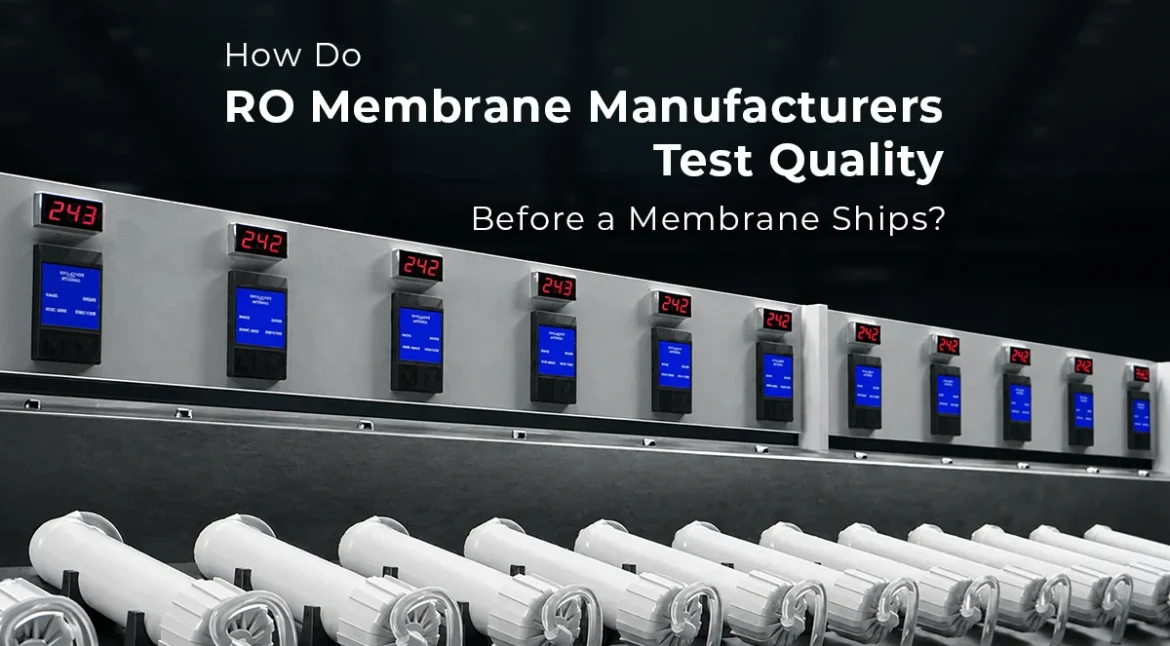
A wet test evaluates how the membrane behaves under controlled operating conditions. The element is exposed to a prepared feed solution at specified pressure, temperature and recovery conditions. Test equipment then measures key outputs such as permeate flow and salt rejection.
Salt rejection indicates how effectively the membrane reduces dissolved salts under the test conditions. Permeate flow shows how much purified water the element produces. Both results must be considered together: unusually high flow with weak rejection may point to leakage or membrane damage, while very low flow may indicate excessive resistance, compaction or a construction issue.
Because membrane performance changes with temperature, pressure and feed-water chemistry, responsible manufacturers compare results under defined and repeatable conditions rather than relying on an uncontrolled tap-water check.
5. Visual inspection after testing
After performance testing, the membrane is checked again for telescoping, deformation, loose wrapping, damaged seals or other changes caused by pressure. Labels and batch markings are verified, and test results are linked to the production lot. Any element outside the approved range should be segregated rather than mixed with saleable stock.
6. Preservation, packing and dispatch checks
Wet-tested membranes must be handled carefully after the test. Depending on the product and process, an element may be shipped dry or preserved in an appropriate storage solution. Packaging should protect it from contamination, drying, impact and prolonged exposure to unsuitable temperatures.
The final dispatch check normally confirms the model, quantity, batch details, packaging condition and supporting documents. Clear storage and installation instructions are also valuable, especially when products will move through multiple warehouses before use.
What buyers should ask a membrane supplier
A polished outer label does not reveal how consistently a membrane has been made. Before choosing a supplier, an RO brand or wholesaler should ask practical questions about the quality process:
- Which performance parameters are tested and under what feed-water conditions?
- Is testing carried out on every element, by batch sampling or through another documented plan?
- Can the supplier provide declared flow and rejection specifications for the model?
- Are raw-material lots and finished products traceable?
- How are rejected products separated from approved stock?
- What preservation, shelf-life and storage guidance is provided?
- How does the supplier handle performance complaints and root-cause analysis?
The strongest answer is not simply ‘quality checked’. It is a clear explanation of what is checked, how it is measured and how results are controlled.
Choosing consistency, not just a specification
Two membranes can carry the same nominal capacity and still behave differently if their construction and testing controls are inconsistent. Buyers should therefore compare suppliers on repeatability, traceability, technical documentation and support, not only on price or a single headline figure.
Lexcru works with RO brands, distributors and water-treatment businesses across a broad component portfolio. When evaluating an RO membrane requirement, the right starting point is the application: feed-water condition, purifier capacity, operating pressure, housing compatibility and expected output. Matching the membrane correctly, and sourcing it through a quality-led component partner, helps the complete RO system perform more predictably.