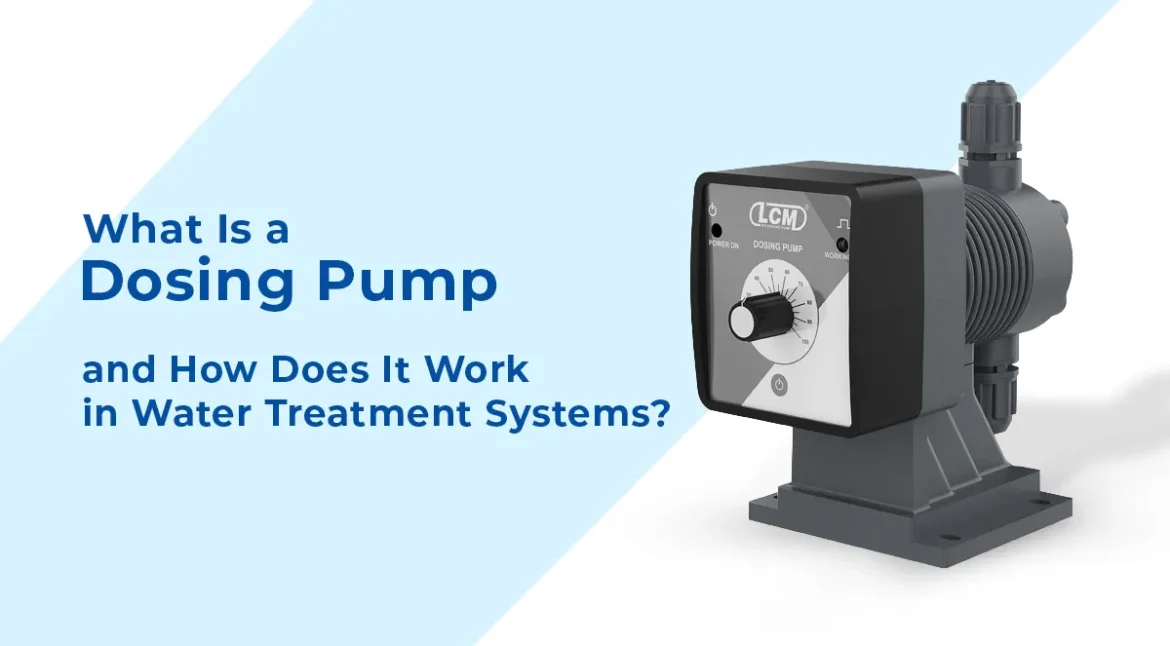
Water treatment often depends on adding a precise quantity of chemical to a moving stream of water. Too little chemical may leave the process ineffective; too much can waste material, increase operating cost or push water outside the required control range. A dosing pump is designed to deliver that chemical in a measured and repeatable way.
For buyers comparing options for a dosing pump in India, selection should begin with the chemical, required dose and system pressure. Flow rate is important, but it is only one part of choosing a pump that can operate safely and accurately.
What is a dosing pump?
A dosing pump, also called a metering pump, is a positive-displacement pump that injects a controlled volume of liquid chemical into a process line or tank. It is used where the dosing rate must be adjustable and repeatable rather than dependent on gravity or manual pouring.
In water and wastewater treatment, dosing pumps may feed disinfectants, pH-adjustment chemicals, coagulants, antiscalants, nutrients or other treatment chemicals. The chemical and application determine the required pump-head material, capacity, pressure rating and control method.
How does a diaphragm dosing pump work?
A common design uses a flexible diaphragm and two non-return valves. During the suction stroke, the diaphragm moves back and creates space in the pump head. Pressure falls, the inlet valve opens and chemical is drawn from the storage tank into the chamber.
During the discharge stroke, the diaphragm moves forward. The inlet valve closes, the outlet valve opens and the measured volume is pushed into the injection line. Repeating these strokes creates a controlled flow. Because the diaphragm separates the drive mechanism from the liquid, the pump can handle many treatment chemicals without the process fluid contacting moving mechanical parts behind the diaphragm.
The actual dose is adjusted through stroke length, stroke frequency, motor speed or digital control, depending on the design. Mechanical pumps may deliver a preset volume when triggered, while digital pumps can vary dosing more precisely and respond to external signals.
Main parts of a dosing system
The pump is only one part of a complete dosing arrangement. A typical system includes:
- Chemical tank: Stores the treatment solution and should be compatible with it.
- Suction line and foot valve: Draw chemical from the tank while helping prevent solids or debris from entering the pump.
- Pump head and diaphragm: Create the suction and discharge strokes.
- Inlet and outlet check valves: Control one-way movement through the pump head.
- Discharge tubing: Carries the chemical towards the treatment point.
- Injection valve: Introduces chemical into the pressurised water line and helps prevent backflow.
- Controls or sensors: Start, stop or vary the dose based on flow, pulse, level, pH, oxidation-reduction potential or another process signal.
- Pressure-relief and back-pressure devices: Protect the line and help maintain stable dosing where the application requires them.
Where dosing pumps are used in water treatment
Dosing pumps serve different purposes across domestic, commercial, industrial and municipal treatment:
- Disinfection: Feeding sodium hypochlorite or another approved disinfectant at a controlled rate.
- pH correction: Adding acid or alkali to bring water towards the required operating range.
- Coagulation and flocculation: Dosing chemicals that help fine suspended particles combine for easier separation.
- RO pretreatment: Feeding antiscalant to reduce the risk of mineral scale on membranes.
- Dechlorination: Adding a reducing chemical before chlorine-sensitive RO membranes where the process design calls for it.
- Boiler and cooling-water treatment: Maintaining treatment-chemical concentration within a controlled programme.
- Wastewater treatment: Dosing pH-control chemicals, coagulants, nutrients or polymers as required by the process.
Chemical selection and dose must be established by a qualified water-treatment professional. A dosing pump controls delivery; it does not determine whether a chemical is appropriate for the water or the intended use.
How the required dosing rate is calculated
The starting calculation links water flow, target chemical dose and solution concentration. If the water flow rises, the chemical feed normally needs to rise in proportion. If the prepared solution is more concentrated, a smaller liquid volume is required to deliver the same mass of active chemical.
In practice, the calculation must also consider the chemical’s actual strength, density where relevant, process demand, reaction time and residual target. After installation, the delivered volume should be calibrated because tubing condition, suction lift, back pressure and liquid properties can affect real output.
Control methods: manual, proportional and feedback dosing
A basic pump can run at a manually selected rate. This may suit a process with stable water flow and stable demand, provided operators routinely verify the result.
In proportional dosing, the pump receives pulses or an analogue/digital signal from a flow meter or controller and adjusts output with water flow. This is more suitable when demand changes through the day.
Feedback dosing uses a process measurement such as pH, chlorine residual or oxidation-reduction potential. A controller compares the measurement with a setpoint and changes the dosing command. Feedback improves control but requires correct sensor placement, calibration and response settings.
How to select a dosing pump
A technically suitable pump should be selected against the full application:
- Required capacity: Determine the normal and maximum dose, then choose a pump that operates controllably within that range.
- Discharge pressure: The pump must overcome pressure at the injection point plus losses in the line.
- Chemical compatibility: Check the pump head, diaphragm, valve, seal and tubing materials against the exact chemical and concentration.
- Suction conditions: Consider suction lift, liquid viscosity, vapour tendency, tank location and line length.
- Control requirement: Decide whether manual adjustment, pulse input, analogue signal, timer, batch mode or closed-loop control is needed.
- Power supply and environment: Confirm voltage, enclosure protection, ambient temperature and exposure conditions.
- Maintenance access: Valves, diaphragm, tubing and calibration equipment should be accessible without creating unsafe handling.
Installation and commissioning basics
The chemical tank and pump should be located in a ventilated, accessible area with suitable containment. Suction tubing should be short, correctly sized and free from air leaks. The injection point should be selected to promote mixing while preventing process water from flowing back into the chemical line.
Before normal operation, the pump is primed, checked for leakage and calibrated by measuring actual delivery over a known period or number of strokes. Safety data sheets, personal protective equipment and chemical-handling procedures must be followed. Never mix chemicals or change wetted materials without confirming compatibility.
Common dosing problems
- Loss of prime due to an empty tank, air leak or gas formation.
- Blocked or dirty check valves causing irregular flow.
- Incorrect calibration after a change in back pressure or solution strength.
- Chemical crystallisation in the pump head or injection valve.
- A damaged diaphragm or incompatible tubing material.
- Sensor drift causing a feedback-controlled pump to overfeed or underfeed.
- Siphoning when the discharge point is lower than the tank and the line is not correctly controlled.
Operators should investigate the cause before increasing the pump setting. Raising the setting may temporarily hide a blocked valve or weak suction condition while making the overall dose less predictable.
Choosing a dependable dosing solution
A good dosing pump delivers the required quantity repeatedly, remains compatible with the chemical and integrates with the process controls. The best result comes from treating the pump, accessories, calibration method and safety arrangement as one system.
Lexcru supports water-treatment businesses with component solutions across different applications. When discussing a dosing requirement, share the chemical name and concentration, target dose, water flow, discharge pressure, control signal and installation conditions. These details make selection more accurate and reduce avoidable commissioning problems.