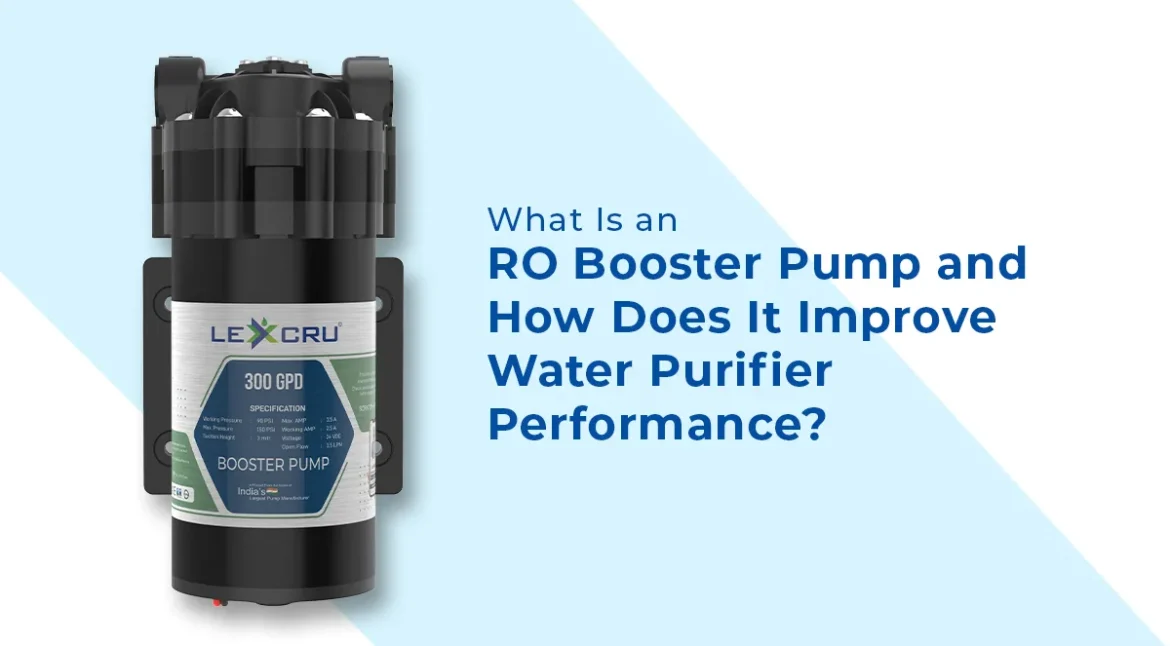
An RO purifier needs pressure to work. When incoming water pressure is too low, the membrane cannot separate water efficiently, and the purifier may take longer to fill its storage tank. An RO booster pump solves this problem by raising the feed-water pressure before water reaches the membrane.
For anyone searching for the best RO booster pump in India, the important question is not which pump has the biggest number on its label. The better question is whether the pump is correctly matched to the membrane, flow restrictor, power supply and pressure controls of the purifier.
What is an RO booster pump?
An RO booster pump is a compact electrically driven pump installed in the purifier’s feed-water line. Most domestic systems use a diaphragm-style pump powered by a DC adapter. The pump draws pre-filtered water, increases its pressure and sends it towards the membrane housing.
The pump normally works as part of a control circuit. A low-pressure switch can stop operation when feed water is unavailable, while a high-pressure switch can stop the pump when the storage tank is full. A solenoid valve controls water entry, and a flow restrictor maintains the pressure relationship required across the membrane.
Why pressure matters in reverse osmosis
Reverse osmosis works by applying pressure greater than the natural osmotic pressure of the dissolved salts in feed water. This pressure drives water molecules through the membrane while much of the dissolved load remains in the reject stream.
When feed pressure drops below the system’s practical operating range, purified-water production can fall. The purifier may also send a greater share of water to drain, take longer to fill or show inconsistent TDS reduction. The exact effect depends on the membrane, feed-water TDS, temperature and system design.
How a booster pump improves purifier performance
A correctly selected booster pump can improve several aspects of day-to-day purifier operation:
- More stable membrane pressure: The membrane receives a more consistent feed pressure even when building or municipal supply pressure fluctuates.
- Better purified-water production: Adequate pressure helps the membrane produce closer to its intended flow under the actual water conditions.
- Faster tank filling: Improved permeate production can reduce the time required to refill the storage tank after use.
- More predictable rejection: Stable operating conditions support more consistent separation, although membrane quality and feed-water chemistry remain equally important.
- Improved system control: When correctly integrated with switches and valves, the pump starts and stops with the purifier instead of running unnecessarily.
When does an RO purifier need a booster pump?
A pump is commonly required when the inlet pressure available at the purifier is below the membrane or purifier manufacturer’s recommended range. This can happen in homes supplied from overhead tanks, on upper floors, in areas with irregular municipal pressure or where long and narrow inlet tubing creates additional pressure loss.
Low output does not automatically mean the pump is faulty or missing. Choked pre-filters, a blocked flow restrictor, a fouled membrane, air in the inlet, a weak adapter or a closed valve can create similar symptoms. Pressure should be measured at the relevant point before a component is replaced.
How to choose the right RO booster pump
Pump selection should be based on the complete hydraulic and electrical system. Key checks include:
- Membrane capacity: The pump must supply enough feed flow for both permeate production and reject flow.
- Operating-pressure range: The useful pressure must match the membrane and purifier design without exceeding the safe limit of housings, tubing or fittings.
- Voltage and adapter capacity: A 24 V pump must be paired with the correct 24 V DC supply, while current capacity should support the pump under load.
- Bypass setting: Fixed or adjustable bypass designs limit maximum discharge pressure. The setting should suit the system rather than being changed blindly.
- Duty cycle and thermal behaviour: The pump should tolerate the purifier’s expected run time without repeated overheating or shutdown.
- Noise and vibration: Good mounting, sound feet and correct tubing reduce transmitted vibration. Noise alone should not be judged without checking installation.
- Material and connection compatibility: Pump-head materials, port size, fittings and tube diameter must suit potable-water use and the intended purifier layout.
Installation details that affect pump performance
Even a suitable pump can underperform if installed incorrectly. The inlet should receive an uninterrupted supply of pre-filtered water, and the pump chamber should not draw air. Aquatec’s troubleshooting guidance notes that the inlet chamber must remain flooded because air ingestion reduces performance.
Technicians should check the direction-of-flow arrow, avoid sharply bent tubing, secure all connections and place the pump where heat can dissipate. The electrical terminals and control switches should be connected according to the purifier’s circuit design. A pressure gauge is useful during commissioning because it confirms what the pump is actually delivering under flow, not merely its no-flow pressure.
Common signs of a booster-pump problem
- The purifier runs for much longer than usual to fill the tank.
- The pump starts and stops rapidly instead of running steadily.
- There is strong vibration, unusual noise or excessive heat.
- The pump runs but little water reaches the membrane.
- Pressure remains low even after pre-filters and inlet supply are checked.
- The pump does not stop when the tank is full.
These symptoms can also point to another component. Rapid cycling may involve a pressure switch or tank, while continuous running may involve leakage, low feed supply, the membrane, the flow restrictor or the high-pressure cut-off. Diagnosis should follow the water path and control circuit in sequence.
A better way to identify the best pump
The best pump is the one that delivers the required pressure and feed flow reliably within the purifier’s safe operating limits. Oversizing can increase noise, stress fittings and waste power; undersizing leaves the membrane short of pressure. A stable, correctly matched unit is more valuable than a pump chosen only by claimed maximum pressure or price.
Lexcru supplies RO components for brands, assemblers, distributors and service networks. For a booster-pump requirement, sharing the membrane capacity, inlet-pressure range, voltage, expected flow and purifier layout helps identify a more suitable component combination.